Kur miqësia harrohet dhe historia shtrembërohet: Zelenski në Beograd dhe hija e Vuçiqit mbi Kosovën
Deklaratat e presidentit ukrainas Volodymyr Zelenski në Beograd, se Ukraina nuk e njeh pavarësinë e Kosovës dhe se nuk do ta njohë atë si shtet, nuk janë thjesht një deklaratë diplomatike. Ato janë një mesazh politik që prek një nga plagët më të ndjeshme të Ballkanit dhe, mbi të gjitha, vjen në një moment kur Serbia e Aleksandër Vuçiqit vazhdon të luajë një rol të dyfishtë mes Moskës dhe Perëndimit.
Reagimi i Sali Berishës dhe i Partisë Demokratike është i drejtë në thelb: një deklaratë e tillë nuk mund të kalojë si një episod i zakonshëm diplomatik.
Kosova nuk është një çështje abstrakte juridike.
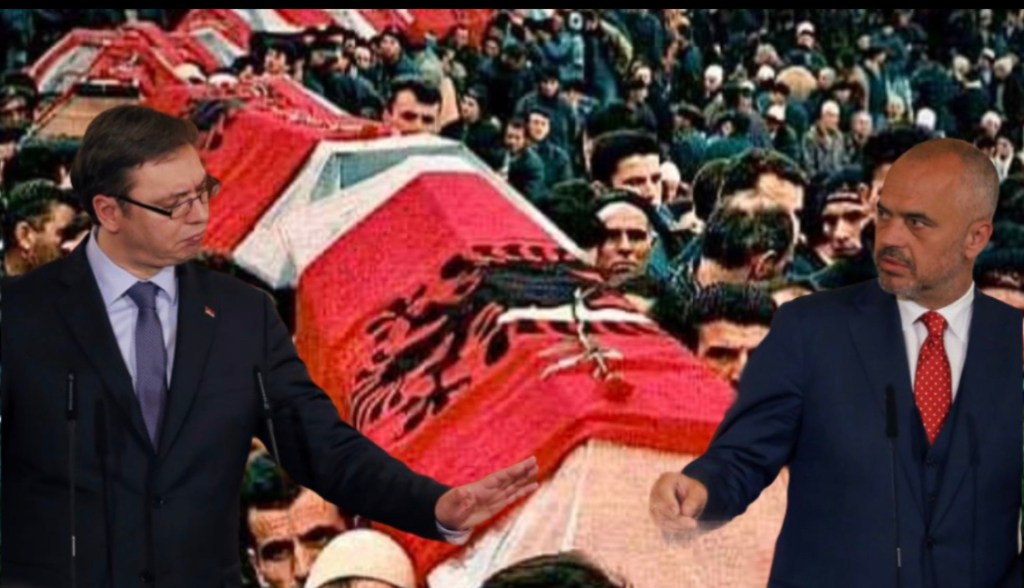
Pas saj qëndron një histori e gjatë represioni, dhune, spastrimi etnik dhe krimesh të kryera nga regjimi i Slobodan Millosheviçit kundër shqiptarëve të Kosovës.
Pas saj qëndron lufta e Ushtrisë Çlirimtare të Kosovës, sakrifica e mijëra shqiptarëve dhe ndërhyrja e NATO-s për të ndalur katastrofën humanitare.
Prandaj, kur një president i një vendi që sot lufton kundër një agresioni të huaj për mbijetesën dhe integritetin e vet territorial shfaqet në Beograd dhe përsërit një qëndrim që i shkon për shtat narrativës serbe, pyetja është e pashmangshme: a është kjo vetëm diplomaci, apo është një lëshim politik ndaj Vuçiqit?
Ukraina dhe Kosova: dy histori që nuk mund të barazohen mekanikisht
Ukraina ka të drejtë të kërkojë mbështetjen e botës për sovranitetin dhe integritetin territorial të saj. Shqiptarët e kanë kuptuar këtë më mirë se shumë popuj të tjerë.
Shqipëria dhe Kosova kanë qenë në krah të Ukrainës që nga dita e parë e agresionit rus. Shqiptarët kanë dënuar pushtimin rus, kanë mbështetur popullin ukrainas dhe kanë qëndruar në anën e një vendi që lufton për lirinë e vet.
Por pikërisht për këtë arsye, Zelenski duhet të kuptojë edhe dhimbjen dhe historinë e Kosovës.
Serbia e viteve ’90 nuk ishte një viktimë e pafuqishme e historisë. Regjimi i Millosheviçit ishte përgjegjës për luftëra, represion dhe krime në hapësirat e ish-Jugosllavisë. Në Kosovë, shqiptarët përjetuan një sistem të gjerë diskriminimi dhe dhune, i cili kulmoi me luftën dhe dëbimin masiv të popullsisë.
Ndërhyrja e NATO-s nuk ishte një aventurë e rastësishme ushtarake. Ajo erdhi pas dështimit të përpjekjeve diplomatike dhe përballë një krize humanitare që po përshkallëzohej.
Prandaj, të flasësh sot për Kosovën vetëm si një “shpallje të njëanshme pavarësie”, pa përmendur historinë që e solli atë deri aty, është një reduktim i rrezikshëm i realitetit.
Vuçiqi nuk është thjesht një mikpritës
Zelenski nuk shkoi në një Beograd neutral.
Ai shkoi te Aleksandër Vuçiqi — një lider që vazhdon të mbajë lidhje të ngushta me Moskën, ndërsa njëkohësisht përpiqet të ruajë marrëdhëniet me Perëndimin.
Në këtë kontekst, çdo deklaratë për Kosovën ka peshë shumë më të madhe sesa fjalët e zakonshme diplomatike.
Vuçiqi e ka ndërtuar një pjesë të rëndësishme të politikës së tij mbi çështjen e Kosovës. Për të, Kosova nuk është vetëm një çështje territoriale; është një instrument politik, emocional dhe elektoral. Sa herë që Beogradi përballet me presion ndërkombëtar, çështja e Kosovës rikthehet si një mjet mobilizimi nacionalist.
Prandaj një deklaratë e fortë nga një lider ndërkombëtar në Beograd mund të interpretohet në Beograd si një fitore diplomatike.
Dhe pikërisht këtu qëndron shqetësimi.
Serbia nuk mund të jetë njëkohësisht “e vogla Rusi” dhe partner i privilegjuar
Për vite me radhë, Serbia ka mbajtur një politikë të ekuilibrit mes Lindjes dhe Perëndimit. Por lidhjet e saj politike, energjetike dhe strategjike me Rusinë nuk mund të injorohen.
Në një kohë kur Ukraina lufton kundër agresionit rus, çdo forcim i pozitës së Beogradit duhet parë me kujdes.
Sepse Rusia e Vladimir Putinit ka një interes të qartë në destabilizimin e Ballkanit.
Një Ballkan i përçarë është më i dobët.
Një Ballkan ku Serbia ushqen tensione me Kosovën është më i brishtë. Dhe një Ballkan ku çështja e Kosovës përdoret vazhdimisht si instrument nacionalist është një Ballkan ku Moska mund të gjejë hapësirë për ndikim.
Prandaj, çdo sinjal që forcon narrativën e Beogradit duhet të trajtohet me përgjegjësi.
Shqiptarët nuk kërkojnë privilegj. Kërkojnë drejtësi.
Shqiptarët nuk i kërkojnë Ukrainës një borxh politik.
Por miqësia ka edhe një dimension moral.
Nëse Kosova ka qëndruar në krah të Ukrainës kur Rusia pushtoi territorin e saj, është e natyrshme që shqiptarët të ndihen të zhgënjyer kur dëgjojnë nga presidenti ukrainas një qëndrim që duket se i jep oksigjen narrativës së Beogradit.
Kjo nuk do të thotë se Ukraina duhet të njohë çdo shtet që Shqipëria apo Kosova njeh.
Por do të thotë se historia duhet respektuar.
Nuk mund të kërkosh nga bota të kuptojë tragjedinë e Buchës, Mariupolit, Irpin-it dhe qyteteve të tjera ukrainase, ndërsa tragjedia e Kosovës reduktohet në një formulë diplomatike mbi “shpalljen e njëanshme”.
Dhimbja e një populli nuk bëhet më pak e vërtetë sepse ndodh në një cep tjetër të Evropës.
Kosova nuk është monedhë këmbimi
Këtu qëndron edhe thelbi i reagimit të Partisë Demokratike.
As NATO nuk mund të relativizohet. As historia e luftës së Kosovës nuk mund të fshihet. As vendimi i Gjykatës Ndërkombëtare të Drejtësisë për deklaratën e pavarësisë së Kosovës nuk mund të trajtohet sikur nuk ekziston.
Kosova është sot një realitet politik dhe shtetëror i njohur nga një pjesë e madhe e komunitetit ndërkombëtar dhe nga shumica e vendeve të NATO-s dhe BE-së.
Mund të ketë mosmarrëveshje diplomatike për njohjen e saj. Por nuk mund të ndërtohet një histori e re duke fshirë historinë që e parapriu.
Një paralajmërim për Perëndimin
Deklarata e Zelenskyt duhet të shërbejë edhe si një paralajmërim për Evropën.
Prandaj, Perëndimi nuk duhet ta shohë Kosovën si një problem të bezdisshëm që duhet “menaxhuar” për t’i bërë qejfin Beogradit.
Kosova është pjesë e zgjidhjes së sigurisë së Ballkanit.
Dhe një Serbi që kërkon të afrohet me Evropën duhet të kuptojë se e ardhmja nuk ndërtohet duke ushqyer mitet e së kaluarës.
Në fund mbetet një pyetje
Nëse Ukraina kërkon nga bota të mos e njohë pushtimin rus të territoreve të saj, mbi çfarë parimi duhet t’u kërkohet shqiptarëve të harrojnë atë që ndodhi në Kosovë?
Nëse sovraniteti dhe e drejta e një populli për të jetuar i lirë janë parime universale, atëherë ato nuk mund të aplikohen sipas miqësive të momentit.
Dhe nëse Rusia është një kërcënim për sigurinë evropiane, atëherë Perëndimi duhet të jetë veçanërisht i kujdesshëm me çdo politikë që forcon aktorët që mbajnë ende lidhje të forta me Moskën.
Zelenski kishte të drejtë të kërkonte solidaritet për Ukrainën.
Sepse Kosova nuk është një kartë në tavolinën e negociatave.
Kosova është rezultat i një historie të dhimbshme, i një lufte për liri dhe i një ndërhyrjeje ndërkombëtare që ndryshoi historinë e Ballkanit.
Dhe çdo përpjekje për ta kthyer këtë histori mbrapsht nuk i shërben paqes.
I shërben vetëm atyre që duan një Ballkan të dobët, të përçarë dhe të destabilizuar.
Dhe pikërisht këtu, shqetësimi më i madh nuk është vetëm deklarata e Zelenskyt. Është fakti se një deklaratë e tillë, në Beograd dhe në prani të Vuçiqit, mund të kthehet në një dhuratë politike për serbomadhinë dhe në një fitore strategjike për Moskën.
🇦🇱🇽🇰🇺🇸🇪🇺
When Friendship Is Forgotten and History Is Distorted: Zelensky in Belgrade and Vučić’s Shadow Over Kosovo
If Kosovo stood shoulder to shoulder with Ukraine from the very first day of Russia’s aggression, Albanians have every right to feel disappointed when Ukraine’s president, standing in Belgrade, delivers a message that appears to strengthen the very narrative promoted by Vučić and Belgrade against Kosovo.
Kosovo is not a bargaining chip. Kosovo is not a footnote in European history. And Kosovo must never become the price of a diplomatic embrace between Kyiv and Belgrade.
Kosovo is an integral part of European security. Serbia is a key actor in the Balkans. Russia has strategic interests in the region. And every new tension between Belgrade and Pristina creates an opportunity for Moscow to divide Europe, weaken the West, and expand its influence.
The statements made by Ukrainian President Volodymyr Zelensky in Belgrade — that Ukraine does not recognize Kosovo’s independence and will not recognize it as a state — cannot simply be dismissed as routine diplomacy.
They carry a profound political message.
They touch one of the most sensitive wounds in the Balkans and come at a particularly troubling moment, when Aleksandar Vučić’s Serbia continues to maneuver between Moscow and the West, maintaining close political and strategic ties with Russia while presenting itself as a partner of Europe.
The reaction of Sali Berisha and the Democratic Party is therefore justified in principle: such a statement should not be treated as an ordinary diplomatic detail.
Kosovo is not an abstract legal question.
Behind Kosovo lies decades of repression, discrimination, violence, ethnic cleansing, and crimes committed by Slobodan Milošević’s regime against the Albanian population.
Behind Kosovo lies the sacrifice of thousands of Albanians, the resistance of the Kosovo Liberation Army, the suffering of an entire population, and NATO’s intervention to prevent a humanitarian catastrophe.
That history cannot simply be erased from the diplomatic record.
Therefore, when the president of a country fighting for its own survival and territorial integrity against a foreign aggressor arrives in Belgrade and reiterates a position that directly benefits the Serbian narrative, an unavoidable question emerges:
Is this simply diplomacy — or is it a political concession to Vučić?
Ukraine and Kosovo: Two Histories That Cannot Be Reduced to the Same Formula
Ukraine has every right to demand international support for its sovereignty and territorial integrity.
Albanians understand this better than many.
Albania and Kosovo stood with Ukraine from the first day of Russia’s full-scale aggression. Albanians condemned the Russian invasion, supported the Ukrainian people, and stood on the side of a nation fighting for its freedom and survival.
But precisely because of that solidarity, Zelensky should understand the pain and history of Kosovo.
The Serbia of the 1990s cannot simply be presented as a passive victim of history.
Milošević’s regime was responsible for wars, repression and atrocities across the former Yugoslavia. In Kosovo, Albanians experienced systematic discrimination and violence that ultimately escalated into war, mass expulsions and a humanitarian catastrophe.
NATO’s intervention did not happen in a historical vacuum.
It came after diplomatic efforts had failed and as the humanitarian crisis was rapidly deteriorating.
Therefore, to describe Kosovo today merely as a “unilateral declaration of independence,” while ignoring the history and circumstances that led to it, is not an adequate description of reality.
You cannot erase the road to Kosovo’s independence and then pretend to understand the destination.
Vučić Is Not Merely a Host
Zelensky did not travel to a politically neutral Belgrade.
He travelled to Aleksandar Vučić — a leader who continues to maintain close relations with Moscow while simultaneously seeking closer economic and political ties with the European Union.
That context matters.
Every statement about Kosovo made in Belgrade carries a weight far greater than ordinary diplomatic language.
Vučić has built a significant part of his political strategy around the Kosovo issue. For him, Kosovo is not merely a territorial question. It is also a powerful political, emotional and nationalist instrument.
Whenever Belgrade faces international pressure, Kosovo can once again be placed at the center of political mobilization.
That is why a statement by an internationally respected leader, made in Belgrade and in the presence of Vučić, can be presented domestically as a diplomatic victory.
And that is precisely the danger.
A message intended as diplomacy can become propaganda.
A diplomatic gesture can become political ammunition.
And a sentence spoken in Belgrade can be repeated for years as proof that the Serbian narrative is gaining international legitimacy.
Serbia Cannot Be Both “Little Russia” and a Privileged Partner
For years, Serbia has attempted to maintain a delicate balance between East and West.
But that balancing act cannot hide its continuing political, energy and strategic connections with Russia.
At a time when Ukraine is fighting against Russian aggression, the West must look carefully at the geopolitical consequences of strengthening Belgrade without demanding clear strategic choices.
Russia has a direct interest in instability in the Balkans.
A divided Balkans is a weaker Balkans.
A Balkans in which tensions between Serbia and Kosovo remain permanently unresolved is vulnerable.
And a region in which nationalist narratives are constantly revived creates fertile ground for Russian influence.
Moscow does not necessarily need to create every crisis itself.
Sometimes it only needs to exploit divisions that already exist.
That is why every political signal that strengthens Belgrade’s nationalist narrative should be treated with extreme caution.
Albanians Are Not Asking for Privilege. They Are Asking for Justice.
Albanians are not asking Ukraine to recognize Kosovo simply because Albania and Kosovo recognize it.
Nor are they asking Ukraine to repay a political debt.
But friendship has a moral dimension.
When Kosovo stands with Ukraine during one of the darkest moments in modern European history, it is reasonable to expect Ukraine to understand Kosovo’s own historical trauma.
If Kosovo supported Ukraine when Russia invaded its territory, Albanians have every right to feel disappointed when Ukraine’s president, in Belgrade, delivers a message that appears to strengthen Belgrade’s position.
This does not mean that Ukraine must recognize every state recognized by Albania or Kosovo.
It means something more fundamental:
History must be respected.
The world cannot be asked to understand the tragedies of Bucha, Mariupol and Irpin while the tragedy of Kosovo is reduced to a diplomatic phrase about a “unilateral declaration of independence.”
The suffering of one people does not become less real simply because it happened elsewhere in Europe.
Human suffering has no nationality, and justice cannot have double standards.
Kosovo Is Not a Bargaining Chip
This is at the heart of the reaction from the Democratic Party.
KOSOVO MUST NEVER BECOME A BARGAINING CHIP IN THE RELATIONS BETWEEN GREAT POWERS AND BELGRADE.
The history of the Kosovo War cannot be rewritten.
NATO’s intervention cannot simply be relativized.
The suffering of Kosovo’s Albanian population cannot be erased.
And the International Court of Justice’s 2010 advisory opinion concerning Kosovo’s declaration of independence cannot be treated as if it never existed.
Kosovo is today a political and state reality recognized by a large part of the international community and by the majority of NATO and EU member states.
Countries may disagree diplomatically over recognition.
That is a political reality.
But disagreement over recognition does not give anyone the right to rewrite the history that produced Kosovo’s independence.
Diplomacy cannot be allowed to become historical amnesia.
A Warning to Europe and the West
Zelensky’s statement should also serve as a warning to Europe.
The Balkans are not an insignificant corner of the continent.
Kosovo is part of European security. Serbia is a key actor in the region. Russia has strategic interests in the Balkans. And every new escalation between Belgrade and Pristina can be exploited by Moscow to weaken European unity.
The West must therefore stop treating Kosovo as an inconvenient problem that can simply be “managed” in order to keep Belgrade comfortable.
Kosovo is not the obstacle to Balkan security.
Kosovo is part of the security equation.
And Serbia, if it genuinely wants to move toward Europe, must understand that the future cannot be built by continually reviving the nationalist myths and grievances of the past.
European integration cannot be separated from democratic values, regional stability, respect for neighboring states and the rejection of territorial nationalism.
The Question Zelensky Should Hear
If Ukraine asks the world not to recognize Russia’s occupation of Ukrainian territory, on what principle should Albanians be asked to forget what happened in Kosovo?
If sovereignty matters in Ukraine, why should it become negotiable in Kosovo?
If the right of a people to live freely matters in Kyiv, Bucha and Mariupol, why should the same principle be treated differently in Pristina?
And if Russia represents a threat to European security, why should Europe ignore the strategic consequences of strengthening actors that maintain close political and strategic relations with Moscow?
These are not anti-Ukrainian questions.
They are questions of consistency.
Zelensky has every right to demand solidarity for Ukraine.
But Albanians also have the right to demand that the history of Kosovo not be used as a diplomatic concession in Belgrade.
Kosovo Is Not a Card on the Negotiating Table
Kosovo is not a bargaining chip.
Kosovo is not a diplomatic gift.
Kosovo is not a card that can be played whenever powerful states seek something from Belgrade.
Kosovo is the product of a painful history, a struggle for freedom, the sacrifice of thousands, and an international intervention that fundamentally changed the course of Balkan history.
That history cannot be reversed by political convenience.
Nor should it be rewritten to accommodate the interests of the moment.
Because attempts to turn history backward do not serve peace.
They serve those who want a weak, divided and permanently unstable Balkans.
And this is where the deepest concern lies.
The problem is not only Zelensky’s statement.
The problem is that such a statement, delivered in Belgrade and in the presence of Vučić, can be transformed into a political gift for Greater Serbian nationalism and a strategic opportunity for Moscow.
Ukraine needs friends. Kosovo has been a friend.
Friendship, however, should not require one side to forget its own history.
If Europe truly wants a secure and peaceful Balkans, it must defend principles consistently — not selectively.
And if the West wants to defeat Russian influence in Europe, it must understand one simple truth:
A stable Balkans cannot be built by appeasing nationalism, rewarding historical revisionism, or sacrificing Kosovo for short-term diplomatic convenience.
Jurnalist . AL in Sweden (alinsweden.blog) is an independent WordPress-based blog focusing on Albanian social, historical, and political commentary, international affairs, human rights, and occasional reflections or historical snapshots concerning Sweden.