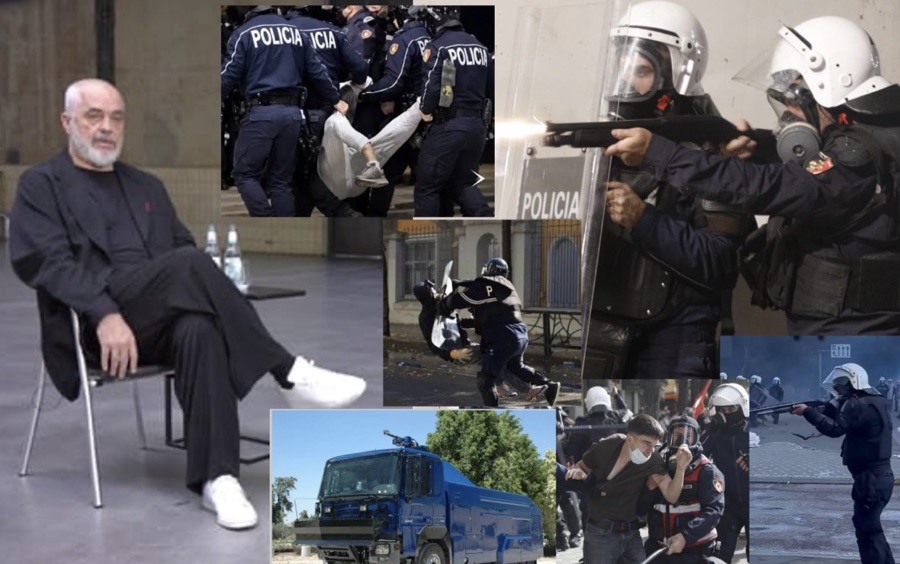
HOW THE ISRAELIS HELPED RAMA CRACK DOWN ON PROTESTERS
✍🏽 Ferdinand Dervishi /
On Saturday, November 7, 2026, the Albanian police showed the public a different side of themselves. They did not confront protesters with their usual arsenal of violence. On the contrary, despite stones, fireworks and some Molotov cocktails, they exercised restraint, used only high-pressure water (without chemicals) and, in several instances, withdrew in the face of resistance from peaceful demonstrators.
By the end, at around 10:00 p.m., the protesters dispersed, and the police cordons, heavily armed and surrounding the Prime Minister’s Office, were dismantled.
On Saturday, the police managed to get through the confrontation with a little patience and by applying the principle of proportionality – in other words, by enforcing the law.
But what changed? Why did the Albanian police retreat from their extreme violence?
Certainly not out of fear, because in Serbia, following the dictator’s downfall, police officers who abused protesters are now being arrested.
Nor because human rights organizations have begun putting pressure on the Albanian Prime Minister from every direction.
The police’s retreat from the brutal abuse of protesters is connected to the sense of security Prime Minister Rama has managed to establish. He has now exhausted every available option and played every card to hold on to power. Practically speaking, there is nothing left for him to add.
He is now convinced that he has everything necessary to bring protests under control: the personnel, the appropriate training, a police force equipped with every type of weapon and equipment and, most importantly, officers who feel well paid.
But how did he reach this point? How did Prime Minister Rama overcome the despair of those first days, when violent protests shook his government?
How did he recover from the image of a broken man that he presented to Albanians on the mornings of October 15–18, 2026?
Increasingly, the evidence suggests that during those days Rama was not waiting for the end, nor was he sitting idle.
His exhausted appearance had another explanation: he had been working day and night, moving every possible piece on the board, seeking help from friends he had cultivated during his long years in power, both at home and abroad. Most importantly, the assistance he requested had been secured.
For these reasons, on October 19, he appeared rejuvenated and even defiant before senior State Police officials, concluding his part of the assignment by announcing €2,500 bonuses for those serving on the front lines of the protests.
The results of his efforts would become evident from that very day, October 19, 2026, when a Turkish Air Force military transport aircraft unloaded two armoured water-cannon vehicles at Tirana International Airport in Rinas, bringing the Albanian police fleet of riot-control water cannons to seven.
Later that night, another military transport aircraft, a Boeing C-17A Globemaster III, arrived in Rinas from the United Arab Emirates. Four more aircraft followed, the last arriving on November 6, 2026.

INTERNATIONAL FLIGHT-TRACKING DATA CONFIRM SIX FLIGHTS TO RINAS DURING THE PROTESTS
According to data recorded by international flight monitoring systems, most flights from the United Arab Emirates used military transit protocols, switching off civilian tracking systems as they approached Balkan airspace in order to maintain the confidentiality of their missions.
Regarding the three aircraft that flew from the UAE to Rinas on October 19, 20 and 22, flight-monitoring data indicate that they transported logistical and support materials.
The fourth aircraft, which arrived in Rinas toward the end of October, was described as a “closed tactical flight”, not visible on public civilian radar systems. The final aircraft, arriving on November 6, 2026, was described as a “ghost flight”, with its civilian transponder switched off.

International flight-monitoring data describe the November 6, 2026, flight from the UAE to Rinas as a “ghost flight”.
At Rinas, neither the materials nor a group of unidentified individuals were subjected to standard legal procedures for leaving the airport area.

The map accompanying the international flight-monitoring data.
The unidentified individuals departed in the direction of Tirana without checking in, using a gate that reminds Albanians of the spectacular 2019 airport robbery, when a group of thieves seized approximately €6 million from inside the airport.
Some of the unidentified individuals subsequently appeared, together with the shipment of materials, at Unit 100, also known as the Technical Materials Supply Centre and warehouses under the authority of the Ministry of Interior and the State Police, located in the Mullet area of Tirana.
Accompanied only by an interpreter and a driver, the unidentified individuals entered the facility without written authorization and without presenting identification documents.
The warehouse received special police equipment and uniforms, large quantities of tear-gas cartridges, a number of weapons designed to fire those cartridges, 100 shotguns capable of firing rubber bullets, corresponding ammunition and other equipment.
The unidentified individuals were seen assembling the weapons and providing instructions on how to use the shotguns designed to fire tear-gas cartridges and rubber bullets.
All the materials were accepted into the warehouses without inspection and acceptance reports, being justified as donations.
Several days later, a prosecutor from the Tirana Prosecutor’s Office visited Unit 100 and questioned the employees responsible. The prosecutor established that the weapons, or shotguns, were unmarked, without any indication of their type or serial numbers. The 40 mm tear-gas cartridges had no manufacturing or expiry dates.
No further investigative actions are known.
The cargo aircraft arriving from the United Arab Emirates also unloaded several trucks at Rinas, two of which were armoured water-cannon vehicles. These were the same vehicles that appeared in front of the Prime Minister’s Office a week or ten days later, on October 31, 2026.
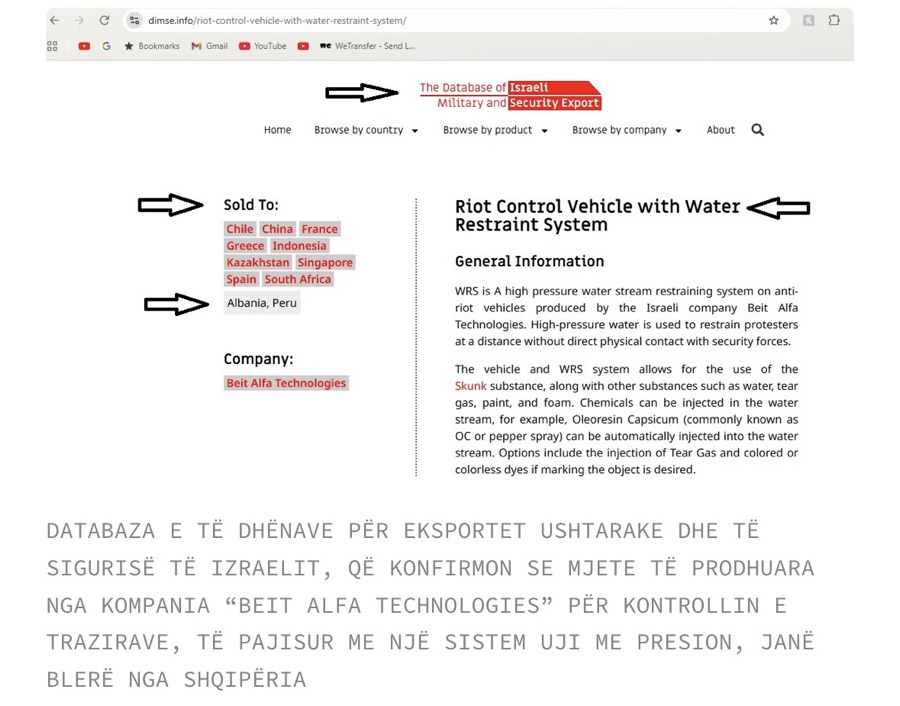
ISRAEL’S MILITARY AND SECURITY EXPORT DATABASE CONFIRMS THAT RIOT-CONTROL VEHICLES MANUFACTURED BY BEIT ALFA TECHNOLOGIES, EQUIPPED WITH HIGH-PRESSURE WATER SYSTEMS, WERE PURCHASED BY ALBANIA
A simple internet search reveals that the armoured water-cannon vehicles are of Israeli manufacture, dating from 2015, specifically produced by the private company Beit Alfa Technologies, which converts vehicles from brands such as Mercedes-Benz and MAN for this purpose.
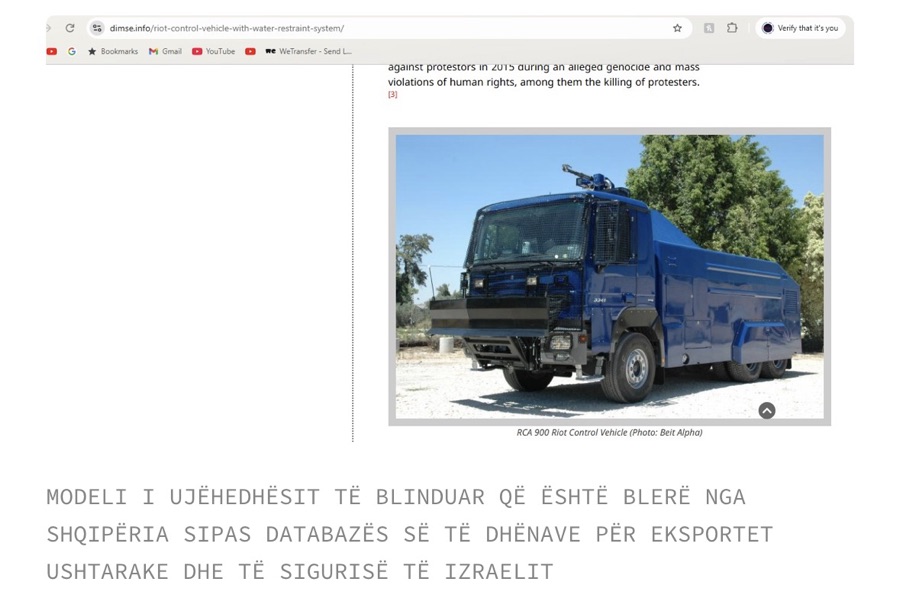
The model of armoured water-cannon vehicle purchased by Albania, according to Israel’s military and security export database.
Visually, the two armoured water-cannon vehicles do not display all the characteristics of those manufactured by the Israeli company Beit Alfa Technologies.
Apparently, both vehicles initially passed through the workshops of Timak Defense, co-owned by Israeli businessman Ron Yeffet, where their external appearance was modified with metal panels and paint. Given the circumstances, it would not be politically convenient for Albanians to discover that these vehicles were manufactured in Israel.
Nevertheless, the evidence concealed in Tirana has not been concealed in Israel.
The black RCA 900 Riot Control Vehicles, the armoured water cannons that Albanians have been seeing decorated with national flags along Dëshmorët e Kombit Boulevard, were purchased in Israel.
This is confirmed by The Database of Military and Israeli Security Exports, which states that riot-control vehicles manufactured by Beit Alfa Technologies, equipped with high-pressure water systems, were purchased by Albania.
No further specific details are provided.
The price of such a vehicle, if purchased new, can reach €1.5 million.
According to information coming from within the State Police, all the vehicles arriving by cargo aircraft at Rinas, as well as 40 new IVECO vans distributed to police stations in Tirana, were paid for by a powerful Albanian businessman (oligarch) close to Prime Minister Edi Rama.
This also explains the statement by State Police Chief Skënder Hitaj, who said that “not a single lek from the state budget was spent” on the new vehicles.
However, in the other part of his statement, when he claimed that “the vehicles were borrowed from partner police forces” and further insisted that “no foreign police officers participated in managing the protests or gave us any advice”, Chief Hitaj was lying.
After October 19, 2026, in the village of Prush, Tirana, in a meadow on the western side of the village reservoir (artificial lake), individuals who, according to several witnesses, wore the Star of David insignia on their uniforms, trained the Rapid Intervention Forces for several consecutive days.
Witnesses told the author of this article that the foreign personnel, whom they identified as Israelis, taught the Rapid Intervention Forces how to use rubber-bullet shotguns, how to throw tear-gas grenades and other exercises.
All the remnants – cartridge cases, pieces of rubber projectiles, plastic-bullet fragments, exploded tear-gas grenades and their components, packaging and other materials – were collected after the training ended. However, evidence remains scattered across the site.
According to several police sources, after October 20, 2026, another group of Israeli specialists was accommodated on the third floor of the Tirana Police Directorate building, where they installed unauthorized surveillance equipment, which they operated for several days and nights.
The most disturbing result of the surveillance operation, from Prime Minister Edi Rama’s perspective, was the interception of communications allegedly confirming the involvement of Tirana Mayor Erion Veliaj and Ergys Agasi, a former coordinator of organized crime gangs, in organizing the violent part of the protests.
The intercepted communications were never made public. They were not only illegal but also deeply ironic and incriminating, since the two individuals under surveillance were – one, the Prime Minister’s former right-hand man, and the other, once his closest friend.
For these reasons, after having both men transferred to more tightly controlled prisons far from Tirana, and in an attempt to present himself as the victim while discrediting the protests as much as possible, the Prime Minister devised and promoted the idea of a conspiracy orchestrated by organized crime.
When questioned about the presence of Israeli experts, the entire leadership chain of the State Police responded to media inquiries with the same formulation:
“Some colleagues from the United Arab Emirates have arrived for training, based on previous agreements.”
The entire scheme to conceal the presence of Israeli experts assisting the Albanian police completes the following picture:
Prime Minister Rama asks his Israeli friends for assistance in dealing with the protests. An Albanian businessman close to him agrees to cover the entire bill, which must amount to several million euros.
Then, to ensure that everything remains secret, the “Made in Israel” equipment and Israeli experts become visible only in the United Arab Emirates – a country known for its friendship and military cooperation with Israel.
As part of this covert operation, after arriving at Rinas, the equipment and, above all, the Israeli experts pass through the airport without leaving any trace in its computer systems. They are then distributed to their destinations under the identity of a group of “police colleagues” who have legally arrived from the United Arab Emirates.
The results of this assistance are known, documented and proven.
The new equipment, rubber-bullet shotguns, weapons and grenades firing tear gas, the increased power of the water cannons manufactured in Israel and, above all, the instructions provided by Israeli experts defeated the violent segment of the protests.
After October 20, 2026, security experts also noticed an immediate change in crowd-control methods.
Protesters were no longer attacked with tear gas only from the front, but also from the flanks and from behind, creating panic and chaos and consequently producing faster results.
From that point onward, after October 20, Albanians would be shocked by footage showing Albanian police formations brutally assaulting underage protesters and young people.
For the first time in almost the entire history of the Albanian police, the force appeared before its own people with the profile of an executioner or a foreign occupying force.
As never before, it charged at protesters as though they were confronting an enemy rather than their own citizens.
Children and young people, more than 1,000 in total, were beaten to the brink between life and death. Thousands of rubber bullets were fired at protesters, targeting their heads and eyes.
The scenes of police dragging away an unconscious young man, his broken leg dangling helplessly, and another young man lying stunned on the ground while a police officer kicked him in the head as if he were a football, would terrorize the Albanian people.
And when this completely transformed behaviour of the police leaves nothing recognizably Albanian about it, not even a trace of the Prime Minister’s advice – or self-advice – about showing empathy towards the people, a logical question arises:
Could it be that the Israeli experts taught our police the methods they themselves have used to suppress Palestinian protests?
Should we suspect that tactics used against protesters whom Israelis regard as terrorists or enemies were employed by the Albanian police against its own people?
What is truly shocking is that a simple internet search reveals that the violence used by Israeli police against Palestinian protesters bears an almost 100 per cent resemblance to the violence employed by Albanian police after October 20, 2026.
Only one element used by Israeli police is missing: shooting live ammunition directly into people’s flesh.
Here are the records:
1. Systematic beatings
Israeli police have used systematic beatings against Palestinian protesters. Detainees have frequently been subjected to severe blows with rubber batons, kicks and punches immediately after arrest, during transportation and while being interrogated.
The Albanian police carried out the same practices, without the slightest mercy.
2. Humiliation and degradation
Israeli police have attempted to break protesters’ dignity through violence accompanied by insults and humiliation, seeking to undermine their humanity and create a sense of total submission.
With the aim of ensuring that they would never dare to protest again, the Albanian police did the same, particularly inside police stations, away from the cameras.
3. Direct firing of tear-gas canisters
Israeli police have fired tear-gas canisters directly at protesters.
According to regulations, tear-gas canisters should be launched into the air to disperse crowds. However, reports indicate that Israeli police have frequently fired them horizontally, directly towards protesters’ bodies or heads, from short distances.
The Albanian police did exactly the same, live and in front of the cameras.
4. Rubber bullets targeting the upper body
Israeli police have repeatedly fired rubber bullets at protesters’ upper bodies.
When fired at the upper body and from close range, in violation of established procedures, rubber bullets frequently cause loss of eyesight, severe fractures or internal organ injuries.
The Albanian police did the same, without hesitation and on a massive scale.
5. The use of “Skunk Water”
Israeli police have also used the so-called “Skunk Water” method. This is a chemical liquid with an extremely foul smell, similar to rotting corpses or sewage, sprayed under high pressure from water-cannon trucks and capable of causing severe nausea and vomiting.
This method, too, has been confirmed as having been used by Albanian police in several instances during the protests.
All the above methods are strictly prohibited under Article 17 of the Albanian Constitution, which requires proportionality when restricting fundamental rights, as well as under the European Convention on Human Rights and other international instruments guaranteeing protection against torture and inhuman or degrading treatment of protesters.
The European Convention establishes that isolated acts of violence by some participants cannot automatically be attributed to the entire demonstration.
In other words, if one individual throws stones or commits an act of violence, this does not strip the entire gathering of its legal protection.
Furthermore, the 2020 United Nations Guidance on Less-Lethal Weapons states that rubber bullets should only be used against the legs of an individual engaged in violence, and only when there is an immediate threat of injury.
Targeting the head, face and neck is therefore strictly prohibited.
Regarding tear gas, the same guidance requires advance warning, sufficient time for people to leave and the provision of a safe escape route for protesters.
Today, the Albanian Prosecutor’s Office – whether SPAK or another competent institution – must conduct an in-depth investigation into this entire massacre, if it has retained even a shred of courage in the face of Prime Minister Edi Rama.
The entire scheme must be investigated, including the arrangements designed to prevent Albanians and other interested parties from discovering the Israeli assistance that arrived in Tirana in violation of numerous laws.
Depending on the evidence, the potential criminal offences could range from abuse of office to violations of customs procedures, smuggling, trafficking in weapons and ammunition, falsification of documents, violations of state controls over military goods, and much more.
But this is not the most serious aspect.
Nor is the most serious issue how much more of Albania and its people’s wealth will be extracted to reward the assistance provided to Edi Rama by the Israelis and his oligarch friend in order to keep him in power.
The most serious fact was demonstrated during Saturday’s protest, November 7, 2026.
Despite the stones, fireworks and Molotov cocktails thrown by protesters, the Albanian police achieved the desired result using only water cannons, without resorting to extreme violence in almost any instance.
Put more simply, on November 7, 2026, the police’s respect for the principle of proportionality demonstrated that the inhuman violence employed until then had been unnecessary.
It is precisely this fact, this truth, that exposes Prime Minister Edi Rama and the Albanian police in an extremely damaging light: they ordered, directed and carried out an unnecessary crackdown against protesters, against Albanian children and young people.
/ Lapsi.al
https://lapsi.al/si-e-ndihmuan-izraelitet-ramen-te-masakronte-protestuesit-i1097982


