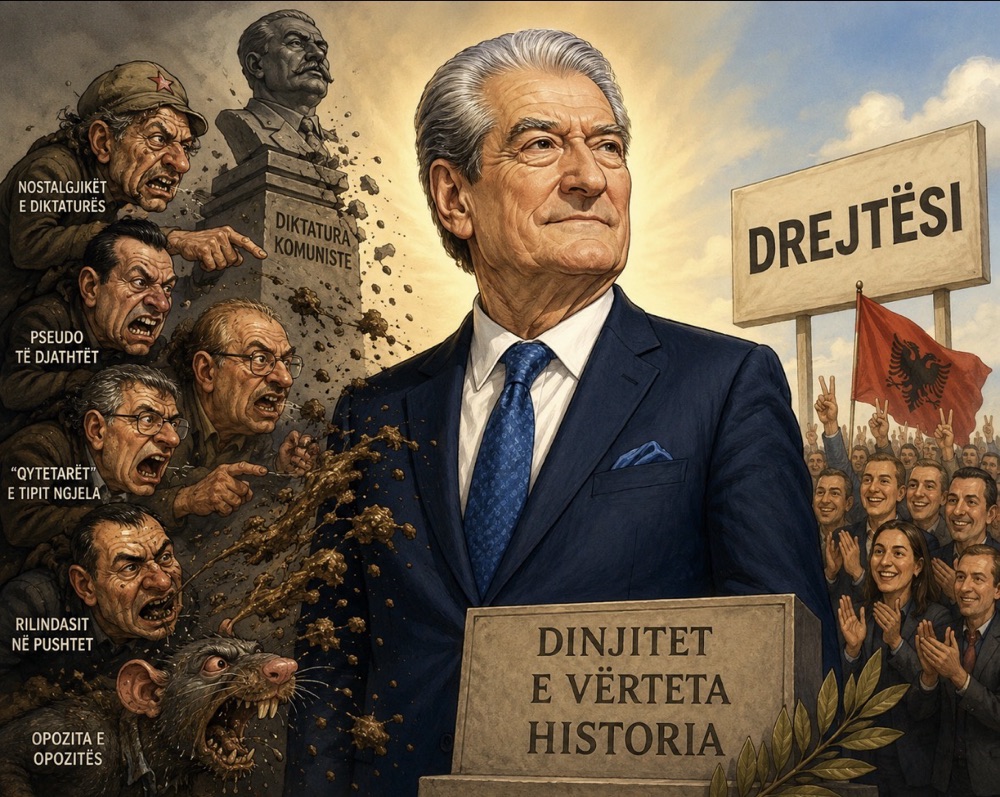
Më në fund, nga Amerika që tani bazohet mbi vlerat mbi të cilat është ndërtuar, Sali Berishës iu vu në vend dinjiteti i marrë padrejtësisht.
Jo pa gabime, njerëzore, sepse gabime ka bërë si çdo politikan, por askush nuk mund t’i mohojë faktin se kemi të bëjmë me një intelektual dhe atdhetar të një klase të veçantë .
Me njeriun që u vu në krye të lëvizjes studentore që rrëzoi diktaturën komuniste dhe bustet e diktatorit.
Pikërisht për këtë arsye nostalgjikët e diktaturës e urrejnë edhe sot. Madje, më shumë se urrejtje, ndaj tij kanë prodhuar shpifje, sepse nuk i falin kurrë shembjen dhe përdhosjen e idealit të tyre.
Nostalgjikët e diktaturës nuk e kanë falur kurrë rolin e tij në rrëzimin e regjimit komunist.
Të tjerë e kanë sulmuar sepse nuk ndërmori hakmarrje politike ndaj kundërshtarëve,
Ndërsa një pjesë e elitave të vetëshpallura nuk e kanë pranuar kurrë faktin se një njeri i ardhur nga provinca arriti të bëhej figura qendrore e politikës shqiptare për dekada.
Pseudo të djathtët e sulmojnë me të njëjtin pasion,
Në respekt të klasës së persekutuar,-Pseudo të djathtët që nuk u kënaqën me dënimet e kupolës komuniste, e sulmojnë me të njëjtin pasion, sepse si presidenti i parë pluralist, Sali Berisha mbas 1992, nuk bëri gjykatësin xhelat por presidentin e popullit edhe ndaj komunistëve, atë që injoranca komuniste bëri ndaj kundërshtarëve të tyre politikë pas vitit 1945.
Nuk ngriti gijotina politike, nuk ndërtoi burgje hakmarrjeje dhe nuk e ktheu tranzicionin në gjueti shtrigash.
Për këtë arsye, paradoksalisht, (disa prej tyre të mbuluar me mantelin e turpit, të ish spiunit të birucave) paturpësisht e kërkojnë fajin dhe e konsiderojnë atë fajtor.
Të ashtuquajturit “qytetarë intelektualë” të tipit Ngjela…
Të ashtuquajturit “qytetarë intelektualë” brumbuj të tipit Ngjela, e Topi kompani, e përçmojnë sepse nuk e pranojnë dot që një “malok”, siç e quajnë ata me përbuzje, erdhi në Tiranë me një valixhe druri, drejtoj revolucionin demokratik rinor, krijoj Partinë Demokratike, dhe i vuri këto “koka të mëdha” në rresht.
Kjo ju djeg më shumë se çdo debat politik.
“Rilindasit” në pushtet …
Hajdutët e “rilindasit në pushtet, si pjella më besnike e sistemit të para vitit 1990, e sulmojnë sepse në çdo denoncim dhe akuzë të tij shohin hijen e lënies me turp të pushtetit, llogaridhënies dhe fundin e pandëshkueshmërisë së abuzimit me pushtetin, vjedhjeve, varfërinë, dhe shpopullimin .
Opozita e opozitës …
Ndërsa opozita e opozitës e ka kthyer pandershmërisht sulmin e saj ndaj Berishës në identitet politik.
Ata veç bizneseve dhe bashkpunimit me pjesë të narkoshtetit, nuk kanë as ide, as kauzë, as betejë tjetër.
Ekzistenca e tyre politike fillon dhe mbaron te sulmi ndaj tij.
Por në të vërtetë, nëpërmjet Non Gradës së Sali Berishës me fakte të sajuara nga neo marksistët, OJQ-të sorosjane, palo mediat e blera dhe pjesa drejtuese e narkoShtetit, ata nuk synuan të godisnin vetëm një individ.
Synimi i tyre ishte më i madh: të cënonin dinjitetin e Partisë Demokratike, të historisë së saj dhe të mijëra njerëzve që u rreshtuan në anën e lirisë kur Shqipëria po dilte nga diktatura.
Por historia nuk fshihet me etiketime majtistësh, dhe as me vendime politike, sepse Amerika e lirisë nuk mund të funksionojë me lobingje të sojit Rama-Yuri Kim- Mc Gonigal-Blinken-Soros.
Partia Demokratike mbetet forca që udhëhoqi ndryshimin historik të vitit 1990 dhe Sali Berisha mbetet një nga figurat kryesore të atij ndryshimi.
Ai mund të kritikohet për gabime, si çdo lider politik, por askush nuk mund t’i mohojë vendin që ka në historinë e pluralizmit shqiptar.
Prandaj, jo vetëm për demokratët, por për gjithë qytetarët që besojnë në demokracia, rivendosja e dinjitetit të Berishës nuk është vetëm çështje personale.
Ajo është edhe rivendosje e dinjitetit të Partisë Demokratike dhe e të gjithë atyre që besuan dhe vazhdojnë të besojnë te vlerat e lirisë, demokracisë dhe pluralizmit.
Sepse kur synon të poshtërosh simbolin, synon të poshtërosh edhe ata që ai simbol përfaqëson.
➡️⏺️➡️⏺️➡️⏺️➡️⏺️➡️⏺️➡️⏺️➡️⏺️➡️⏺️➡️

In the Face of Slander, Dignity Endured
Author: @gjata.com
You can attack a man. You can even slander a leader. But you can never erase history.
Sali Berisha is not simply a politician. He is a figure closely associated with the student movement, the dismantling of the myths of communism, and the birth of political pluralism in Albania.
Not without mistakes—because, like every politician, Sali Berisha has made human errors. Yet no one can deny that he is an intellectual and patriot of a special caliber, the man who stood at the forefront of the movement that brought down the communist dictatorship and the statues of the dictator.
He is the political leader and statesman who helped liberalize the visa regime and led Albania into NATO.
Most recently, from the United States, Sali Berisha’s dignity was restored after what many considered an unjust treatment.
Certainly, he has made mistakes, as every political leader does. However, no one can deny that he is an intellectual and patriot of exceptional standing.
He was the man who led the student movement that overthrew the communist dictatorship and brought down the symbols of that regime.
For precisely this reason, the nostalgics of the dictatorship still resent him today. More than resentment, they have produced slander against him because they have never forgiven him for the collapse and humiliation of their ideological ideal.
Others have attacked him because he did not pursue political revenge against his opponents.
Meanwhile, a segment of the self-proclaimed elite has never accepted the fact that a man from the provinces became the central figure of Albanian politics for decades.
Pseudo-right-wing critics attack him with the same passion because, after 1992, Berisha did not treat former communists—themselves part of the Albanian people—the way the communist regime treated its political opponents after 1945.
He did not build political guillotines, create prisons of revenge, or turn the transition into a witch hunt.
Paradoxically, for this very reason, some of his critics—even those burdened by the shameful legacy of informing and collaboration under the dictatorship—consider him guilty.
The self-proclaimed “intellectual citizens,” figures such as Ngjela, Topi, and others of the same kind, look down on him because they cannot accept that a “highlander,” as they dismissively call him, arrived in Tirana with a wooden suitcase, led the democratic youth revolution, founded the Democratic Party, and ultimately placed these so-called intellectual giants in his shadow.
That reality burns more deeply than any political debate.
Those in power from the so-called “Renaissance” movement, as the most faithful heirs of the pre-1990 system, attack him because in every accusation and denunciation he raises they see the prospect of accountability, the loss of power, and the end of impunity for corruption and abuse.
The opposition to the opposition, meanwhile, has unfairly turned its attacks on Berisha into its entire political identity.
Beyond business interests and cooperation with elements of the narco-state, they possess neither ideas, nor causes, nor meaningful political battles.
Their political existence begins and ends with attacking him.
In reality, through the “non grata” designation imposed on Sali Berisha—based, in the view of his supporters, on fabricated claims promoted by neo-Marxists, Soros-funded NGOs, compliant media outlets, and elements within the narco-state—their objective was never merely to target one individual.
Their broader aim was to undermine the dignity of the Democratic Party, its history, and the thousands of people who stood on the side of freedom when Albania emerged from dictatorship.
But history cannot be erased through labels or political decisions.
The Democratic Party remains the force that led the historic transformation of 1990, and Sali Berisha remains one of the principal figures of that transformation.
He may be criticized for mistakes, as any political leader can be, but no one can deny the place he occupies in the history of Albanian pluralism.
Therefore, for democrats and for all citizens who believe in democracy, the restoration of Berisha’s dignity is not merely a personal matter.
It is also the restoration of the dignity of the Democratic Party and of all those who believed—and continue to believe—in the values of freedom, democracy, and pluralism.
Because when you seek to humiliate a symbol, you also seek to humiliate those whom that symbol represents.
Today, more than ever, Albania needs justice, not political lynching.
It needs fair judgment, not predetermined verdicts.
And when the truth is delayed, it may anger many people, but it does not cease to be the truth.


