On the Recognition and Condemnation of the Serbian Genocide in Kosovo
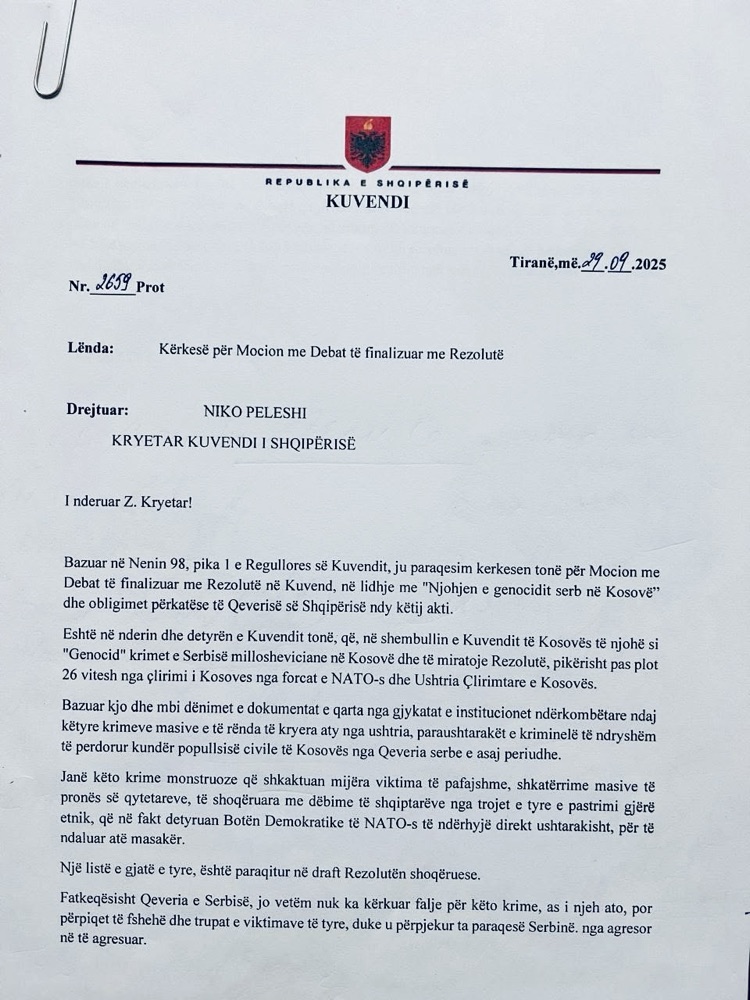
The Assembly of the Republic of Albania,
Having regard to Articles 2, 3, 4, 5, 7, 15, 16, 17, 18, 19, 20, 22, 28, 29, 59, 123, 124, 125, and 126 of the Constitution of the Republic of Albania;
Having regard to the Charter of the United Nations, the Universal Declaration of Human Rights, the International Covenant on Civil and Political Rights, the International Covenant on Economic, Social and Cultural Rights, the Convention on the Prevention and Punishment of the Crime of Genocide (1948), the Geneva Conventions of 1949 and their Additional Protocols, the European Convention on Human Rights, the Convention against Torture and Other Cruel, Inhuman or Degrading Treatment or Punishment, as well as other international instruments ratified by the Republic of Albania;
Recalling the Statute of the International Criminal Tribunal for the former Yugoslavia (ICTY), the judgments of the ICTY, and the jurisprudence of the International Court of Justice regarding the crime of genocide and crimes against humanity;
Taking into account United Nations Security Council Resolution 1244 (1999);
Recalling further the Resolution of the Parliamentary Assembly of the Council of Europe 1329 (2003), the Resolution of the European Parliament of 30 April 2009 on the European integration process of Kosovo, and other resolutions and recommendations of international institutions condemning war crimes and crimes against humanity committed in Kosovo during 1998–1999;
Recognizing the suffering, displacement, massacres, killings, forced disappearances, sexual violence, destruction of property, cultural and religious heritage, and other grave crimes committed by Serbian forces and institutions against the Albanian population of Kosovo;
Affirming that the systematic and widespread acts committed by the Serbian state authorities and military, paramilitary, and police structures during 1998–1999 in Kosovo constitute genocide, crimes against humanity, and war crimes under international law;
The Assembly of the Republic of Albania:
Strongly condemns the genocide, crimes against humanity, war crimes, and ethnic cleansing committed by Serbian state institutions, military, police, and paramilitary forces against the Albanian population of Kosovo during the years 1998–1999. Recognizes that these acts were deliberate, systematic, and widespread, and that they meet the definition of genocide under the 1948 Convention on the Prevention and Punishment of the Crime of Genocide. Pays tribute to the victims of the Serbian genocide in Kosovo, honors the memory of those who lost their lives, and expresses deep solidarity with the survivors, their families, and the entire people of Kosovo. Acknowledges the suffering of over one million Albanians forcibly expelled from their homes, the massacres of thousands of innocent civilians, the systematic sexual violence committed against Albanian women and girls, and the destruction of dwellings, schools, healthcare centers, and religious institutions. Declares that the denial of genocide, the minimization of crimes, and the glorification of war criminals represent a continuation of injustice and are contrary to the principles of peace, reconciliation, and European values. Calls upon the Republic of Serbia to recognize the genocide committed in Kosovo, to apologize publicly to the victims and their families, to cooperate fully in clarifying the fate of the missing persons, to bring before justice all perpetrators of war crimes, and to provide reparations for the damage caused. Urges international institutions, including the United Nations, the European Union, the Council of Europe, and all democratic states, to recognize and condemn the Serbian genocide in Kosovo, and to support justice, truth, and reconciliation in the region.
Massacres Committed by Serbian Forces in Kosovo (1998–1999)
The Assembly of the Republic of Albania, in recalling and documenting the crimes of genocide, enumerates the following massacres committed against the Albanian population of Kosovo:
Prekaz Massacre (March 5–7, 1998): 54 members of the Jashari family, including women and children, killed in Prekaz, Skenderaj. Likoshan and Çirez Massacre (February 28–March 1, 1998): 24 civilians killed by Serbian forces. Prekaz i Ulët (March 5, 1998): 27 Albanians killed. Gllogjan (March 24, 1998): 24 Albanians killed. Poklek Massacre (April 17, 1999): 53 civilians, including 23 children, burned alive. Izbica Massacre (March 28, 1999): 147 civilians executed. Meja and Korenica Massacre (April 27, 1999): over 377 men and boys executed in mass killings. Krusha e Madhe Massacre (March 25–27, 1999): 241 Albanians, including women and children, killed; many bodies burned. Krusha e Vogël Massacre (March 25, 1999): 113 Albanians killed, including 32 under the age of 18. Burgajet, Suhareka Massacre (March 26, 1999): 49 members of the Berisha family killed. Bellanica Massacre (March 25–26, 1999): 86 Albanians executed. Theranda/Suhareka Massacre (March 26, 1999): 350 Albanians killed in different parts of the town. Gjakova Massacre (April 1–2, 1999): 380 civilians executed. Pastasel Massacre (March 31, 1999): 106 Albanians killed. Vushtrri Massacre (May 2–3, 1999): 120 Albanians executed. Dubrava Prison Massacre (May 22–23, 1999): 160 Albanian prisoners executed. Ćikatovë e Vjetër Massacre (April 30, 1999): 94 civilians killed. Bajgora Massacre (April 1999): 98 Albanians executed. Carakllukë Massacre, Peja (April 1999): 70 Albanians killed. Rezalla Massacre (April 5, 1999): 98 Albanians executed. Rreznik Massacre (April 2, 1999): 39 civilians killed. Çikatovë e Vjetër (April 1999): 66 Albanians executed. Staro Çikatovo Massacre (April 1999): 80 Albanians killed. Rakovina Massacre (April 1999): 100 civilians executed. Zahaq Massacre (April 1999): 39 Albanians killed. Korisht Massacre (April 1999): 153 Albanians executed. Suhodoll Massacre (April 1999): 42 Albanians killed. Vrellë Massacre (April 1999): 72 Albanians executed. Qyshk Massacre (May 14, 1999): 41 Albanians killed. Zahaq Massacre (May 14, 1999): 39 Albanians executed. Pavlan and Nakëll Massacres (May 14, 1999): 116 Albanians killed. Kaqanik Massacre (April 1999): 86 Albanians executed. Studime Massacre (May 1999): 100 Albanians killed. Makresh i Ulët Massacre (April 1999): 45 Albanians killed. Bellanica, Rahovec (April 1999): 86 Albanians executed. Drenoc Massacre (April 1999): 36 Albanians killed. Cikatove Massacre (April 1999): 94 Albanians executed. Raskovac Massacre (April 1999): 100 Albanians killed. Krushë e Madhe Massacre (March 1999): over 200 Albanians executed. Klinë Massacre (April 1999): 80 Albanians killed. Suharekë Massacre (March 1999): 50 Albanians killed.
Summary of the Consequences of the Serbian Genocide in Kosovo
The Assembly of the Republic of Albania notes that the genocide and crimes committed by Serbian state institutions during 1998–1999 caused:
The forced expulsion of over one million Albanians from their homes and lands. The killing of more than 13,000 civilians, including children, women, and the elderly. The disappearance of thousands of persons, whose fate remains unresolved to this day. The systematic sexual violence and rape of Albanian women and girls as an instrument of terror and humiliation. The destruction and burning of over 100,000 houses, villages, schools, and healthcare facilities. The targeted destruction of cultural and religious monuments, including mosques, libraries, archives, and Albanian heritage sites. The severe psychological, social, and economic consequences for the people of Kosovo, whose effects continue to be felt today.
Calls and Appeals
Calls upon the Republic of Serbia: To recognize the genocide committed against the Albanians of Kosovo. To issue a public apology to the victims and their families. To cooperate fully with international and Kosovar authorities in clarifying the fate of the missing persons. To bring to justice all perpetrators of war crimes and crimes against humanity. To compensate the victims and their families, as well as the state of Kosovo, for the damages caused by its genocidal campaign. Calls upon international institutions, including the United Nations, the European Union, the Council of Europe, NATO, and all democratic states, to: Officially recognize and condemn the Serbian genocide in Kosovo. Provide continuous support for justice, truth, and reconciliation in the region. Ensure that impunity for crimes of genocide and war crimes is never tolerated.
Conclusions
The Assembly of the Republic of Albania:
Declares that the Serbian genocide in Kosovo represents one of the gravest crimes committed in Europe after the Second World War. Emphasizes that the recognition of genocide and the honoring of the victims are essential for peace, reconciliation, and justice in the Western Balkans and in Europe as a whole. Affirms that denial, minimization, or justification of genocide constitutes a continuation of injustice and poses a serious obstacle to the normalization of relations and lasting peace in the region. Expresses its unwavering solidarity with the Republic of Kosovo, its institutions, and its people, in their pursuit of justice, truth, and dignity. Calls upon the Parliament of Albania, the Assembly of Kosovo, and other democratic parliaments in the region and beyond, to adopt similar resolutions recognizing and condemning the Serbian genocide in Kosovo.
Memorial Day
The Assembly of the Republic of Albania hereby:
Proclaims 15 January as the Day of Commemoration of the Genocide against the Albanians of Kosovo, in memory of the massacre of Reçak (January 15, 1999) and all the victims of the Serbian genocide in Kosovo.
On this day, state institutions, schools, cultural and scientific institutions, as well as the media, are invited to organize commemorative activities dedicated to the remembrance of the victims and the promotion of human rights, peace, and justice.
 AL in Sweden.